
Bruxism: When Grinding and Clenching Begin to Wear Down Your Teeth
What Is Bruxism?
The Mayo Clinic describes bruxism as teeth grinding or clenching. More recent international scientific consensus uses a somewhat broader definition: bruxism is repetitive or sustained activity of the chewing muscles that occurs either while awake or during sleep. It may involve tooth contact, grinding or clenching, but it can also involve bracing or thrusting the jaw without the teeth necessarily touching.[1]
This distinction is important because bruxism itself is not necessarily a disease. Current consensus describes it as a behavior that may be harmless in some people but may become a risk factor for dental or muscular problems when its intensity, frequency, duration, or consequences become significant.[1]
Bruxism is usually divided into two forms:
Awake bruxism occurs while a person is awake and may involve repetitive or sustained tooth contact, clenching, or simply tensing or bracing the jaw. Stress, anxiety, concentration and other emotional or behavioral factors may be associated with awake bruxism, although the relationship is complex and varies from person to person.[1,2]
Sleep bruxism occurs during sleep and consists of rhythmic or sustained activity of the chewing muscles. It frequently occurs around brief changes in sleep and autonomic nervous-system activity called micro-arousals. Sleep bruxism should therefore not be thought of simply as ordinary chewing that occurs because the normal muscle paralysis of REM sleep has failed.[1,3]
Your Teeth Aren’t Supposed to Stay Together All Day
It is important to distinguish bruxism from the brief contact between the upper and lower teeth that occurs during normal chewing and swallowing.
In a relaxed resting position, the upper and lower teeth are normally separated by a small space known as the interocclusal rest space, or traditionally the freeway space. Although dentists have historically used an average of roughly 2–4 mm as a reference, there is considerable normal variation between individuals, and resting jaw position is better considered a range rather than one exact measurement.[4]
Older physiologic studies and dental literature have estimated that normal functional tooth contact occupies only a small portion of the day—often cited at approximately 15–20 minutes in 24 hours. The exact number should not be taken as a biological cutoff, but the useful point is that healthy teeth do not normally need to remain clenched together throughout the day.[5]
Symptoms and Signs Patients May Notice
Many people who grind or clench their teeth are completely unaware that they do it. Sleep bruxism may first be noticed by a spouse or family member who hears grinding sounds at night, while awake clenching may happen unconsciously during work, driving, concentration or stressful situations.
Possible symptoms or findings include:
- grinding or squeaking noises during sleep
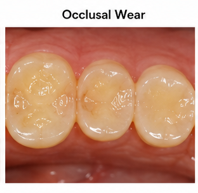
- flattened or worn chewing surfaces
- chipped, cracked or fractured teeth
- worn enamel with underlying dentin becoming visible
- tooth pain or sensitivity
- tired or tight jaw muscles
- jaw or facial soreness, particularly on waking
- difficulty opening or closing the jaw normally
- enlarged chewing muscles, especially the masseters
- pain that resembles an earache when disease of the ear has been ruled out
- headaches, particularly around the temples
- damage or fracture involving fillings, crowns or other dental restorations.[6]
It is important to remember that none of these findings by itself proves that a person currently bruxes. Tooth wear, for example, records everything that has happened to a tooth over many years and may result from a combination of grinding, normal function, acidic erosion, abrasion and previous habits.[7]
How Bruxism Shows Up in the Dental Office
Many of our patients are unaware of their bruxism and first come to us because of its possible consequences. They may notice that their front teeth are getting shorter, a back tooth keeps breaking, fillings seem to fracture repeatedly, or their jaw feels tired in the morning.
For that reason, some of the questions in our health and dental questionnaires are designed to identify possible awake or sleep bruxism, sleep disturbances, jaw-muscle symptoms and related medical conditions.
During an examination we may see findings such as:
- flattened or polished wear facets on posterior teeth
- shortening, thinning or chipping of the incisal edges of front teeth
- fractures or cracks in teeth
- enlarged masseter muscles (the “bull dog face”)
- unexplained morning jaw soreness
- a history of repeated fracture of fillings, crowns or porcelain restorations
- tooth wear occurring together with erosive damage.
Some patients with heavy tooth wear also have mandibular tori—hard bony enlargements commonly found on the tongue side of the lower jaw. Studies have found an association between tori, tooth wear and signs of bruxism, but tori are multifactorial and should not be considered proof that someone grinds their teeth in the absence of other signs of grinding listed above.[8]
What About “Abfractions”?
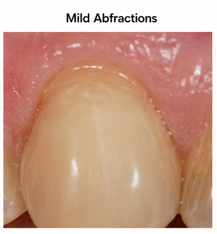
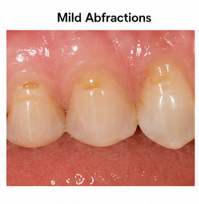
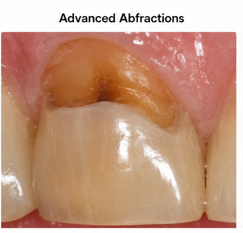
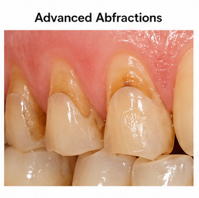
Wedge-shaped defects sometimes develop near the gumline of teeth. These have traditionally been called abfractions, based on the theory that repeated bending of a tooth under heavy bite forces causes the enamel and dentin near the neck of the tooth to break down.
Current evidence suggests that the situation is more complicated. These defects are more appropriately called non-carious cervical lesions, and they probably result from several interacting factors—including mechanical loading, toothbrushing or other abrasion, acids, tooth anatomy and aging. Bruxism may contribute in some patients, but we cannot reliably look at a cervical lesion and conclude that grinding caused it.[9]
When Grinding and Acid Work Together
One particularly destructive combination is mechanical tooth wear plus acid exposure.
Acid can come from outside the body—for example, frequent consumption of soda, energy drinks, citrus products and other acidic foods and beverages—or from inside the body through gastric reflux, recurrent vomiting or regurgitation.
Acid exposure chemically softens and dissolves dental hard tissues. Once dentin is exposed, wear may progress differently and sometimes more rapidly because dentin is less mineralized and more soluble than enamel. Mechanical forces from chewing and bruxism can then act on an already softened surface.[10]
This combination can create characteristic depressions or “cupping” of the chewing surfaces.
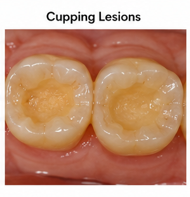
Because tooth wear usually has more than one contributor, identifying why the teeth are wearing is just as important as repairing the damage.
Bruxism and Other Medical Conditions
Bruxism does not exist entirely in isolation from the rest of the body.
Sleep bruxism has been reported in association with sleep-related breathing disorders, including obstructive sleep apnea, although the relationship is complex and having one does not mean that the other is necessarily present or caused by it.[11]
Bruxism has also been reported in association with conditions including Parkinson’s disease, gastroesophageal reflux disease (GERD), epilepsy, dementia, ADHD and some psychiatric conditions. Certain medications—particularly some serotonergic antidepressants—have also been reported to trigger or worsen bruxism in susceptible patients.[6,12]
For this reason, a good dental evaluation includes more than just looking at the wear on the teeth. A patient’s medications, sleep history, medical history and symptoms may provide important clues. When appropriate, the dentist may recommend evaluation by the patient’s physician or a sleep-medicine professional rather than attempting to treat the problem entirely within the dental office.
How We Manage Bruxism and Tooth Wear
Treatment depends on what is actually happening in the mouth, how rapidly it appears to be progressing, whether symptoms are present, and whether teeth or restorations are at risk.
Mild to Moderate Wear
Not every worn tooth needs to be restored for that reason alone.
Shallow non-carious cervical lesions may simply be monitored. If sensitivity is present, we may first address contributing factors such as brushing technique, toothpaste, dietary acids and exposed dentin and use desensitizing or topical treatments when appropriate.
Deeper cervical lesions may occasionally require bonded resin restorations when tooth structure has been substantially lost, sensitivity cannot otherwise be controlled, the lesion compromises the tooth structurally, or restoration is otherwise indicated.[9]
Likewise, mild occlusal wear or cupping may be monitored rather than immediately restored. However, existing wear becomes an important consideration if the tooth subsequently needs a filling, crown or other restoration.
Fractured cusps or teeth may require bonded restorations or crowns depending on the amount and location of the remaining tooth structure. If a fracture damages or exposes the pulp, root canal treatment may sometimes also be necessary. Teeth fractured beyond predictable restoration may ultimately require extraction and replacement with an implant, bridge or removable prosthesis.
Occlusal Guards or “Nightguards”
For many patients with sleep bruxism and evidence that their teeth or restorations are at risk, an occlusal appliance—commonly called a nightguard—may be recommended.
It is important to understand what a nightguard does and does not do.
A nightguard primarily provides a sacrificial protective surface between the teeth and helps redistribute contact. It should not automatically be described as a cure for the neurologic or sleep-related activity responsible for sleep bruxism. Research on whether conventional splints consistently reduce the actual number or intensity of sleep-bruxism episodes has produced mixed results.[13]
That distinction matters: the goal may be to protect the teeth and dental restorations even when the underlying muscle activity continues.
Why Prevention Matters
The early effects of tooth wear are often subtle. Sensitivity, minor recession, cervical lesions and gradual shortening of teeth may develop so slowly that patients regard them as a normal part of getting older.
Some tooth wear does accumulate with age, but severe or rapidly progressive tooth wear should not simply be dismissed as normal aging. When destructive factors continue year after year, comparatively small changes can eventually add up to substantial loss of tooth structure.[14]
Bruxism may also affect the prognosis of restorative dentistry. Repeated high mechanical loading can contribute to fractures or complications involving natural teeth, fillings, ceramics and implant-supported restorations.[15]
Preventing additional destruction is considerably simpler than reconstructing a severely worn dentition.
Severe Tooth Wear and Vertical Dimension
In advanced cases, the front teeth may appear dramatically shortened, and patients sometimes ask whether tooth-colored filling material can simply be added to the ends to make them longer again.
Sometimes additive restorative treatment is possible—but the bite must first be evaluated carefully.
A common misconception is that severe tooth wear automatically means that a patient has “lost vertical dimension,” meaning that the upper and lower jaws have moved substantially closer together. In reality, the dentition can compensate for gradual wear through changes in tooth position and eruption, so a person can have severely shortened teeth while maintaining much of the original vertical dimension of occlusion.[16]
The important question is therefore not simply, “How short are the teeth?” It is, “Where can we safely create the space needed to restore them?”
If restorative material is added indiscriminately to only a few teeth, those teeth may receive excessive contact and the restorations may fail. But modern dentistry also allows intentionally planned changes in the bite. Techniques such as the Dahl concept, for example, can sometimes be used to restore selected worn teeth while allowing the rest of the bite to adapt over time.[17]
The solution therefore ranges from relatively conservative additive treatment to comprehensive reconstruction depending on the severity and distribution of the wear.
Full-Mouth Rehabilitation
When tooth wear is generalized and severe, restoring function and appearance can require treatment across much or all of the mouth.
Historically, this was commonly accomplished with crowns. Crowns and other indirect restorations remain appropriate in many situations, particularly when teeth already contain large restorations or have substantial structural damage.
However, crowning every tooth is no longer the only approach.
Contemporary management of severe tooth wear increasingly emphasizes preservation of remaining tooth structure. Depending on the circumstances, treatment can include direct bonded composite, partial-coverage restorations, crowns, or combinations of these approaches.[14,17]
The bite may intentionally be restored at an increased vertical dimension to create restorative space and improve tooth proportions. Evidence suggests that appropriately planned increases in occlusal vertical dimension are generally well tolerated, although individual patient factors still require careful evaluation.[18]
Temporary restorations or an occlusal appliance may sometimes be useful during treatment planning, particularly in complicated cases or patients with pre-existing jaw symptoms. However, current evidence does not support the idea that every patient’s jaw joint must undergo weeks of testing because opening the bite is inherently likely to make the joint lock or become painful.[18]
Full-mouth rehabilitation remains one of the more complex forms of restorative dentistry because esthetics, phonetics, tooth structure, restorative space, occlusion and long-term mechanical risk all have to be considered together.
When Teeth Can No Longer Be Restored
There are circumstances in which teeth have deteriorated so severely that predictable restoration is no longer possible. If numerous teeth require extraction, complete dentures may sometimes provide an immediate replacement.
For patients planning implant-supported fixed full-arch teeth, a removable or fixed provisional prosthesis may also be used during healing and treatment. These provisional restorations allow esthetics, speech, tooth position and the proposed bite to be evaluated before the final prosthesis is completed.
Whether saving the natural teeth or replacing them is the better option depends on the condition and prognosis of those teeth and requires individual diagnosis; severe wear alone does not automatically mean that extraction is preferable.
The Bottom Line
Bruxism often begins with symptoms that are easy to ignore: a little morning jaw tightness, an occasional chipped edge, mild sensitivity or teeth that seem gradually shorter.
Bruxism itself is not necessarily a disease, and not everyone who grinds or clenches will suffer serious damage. But in patients whose chewing-muscle activity contributes to progressive tooth wear, fractures or repeated failure of dental restorations, recognizing the problem early can make an enormous difference.[1]
The goal is not simply to repair each tooth after it breaks. It is to identify the pattern, determine the other factors contributing to the damage, protect the remaining tooth structure and intervene before a manageable problem becomes a major reconstructive one.
For appropriate patients, something as comparatively simple as an occlusal guard—combined with identification and management of contributing factors—may help protect teeth and restorations from years of additional mechanical damage.
Leave a Reply